University of Pennsylvania · ESE 5190 · Fall 2026
Paw Pulse
Embedded pet monitoring and cloud processing
Paw Pulse connects a modular collar system to motion processing and a phone-accessible dashboard. The work spans sensor acquisition, microcontroller communication, a streaming step counter and the integration of a behavior model into a cloud application.
Technologies: ATmega328PB, ESP32-S3, C, I2C, SPI, UART, TypeScript, Cloudflare D1
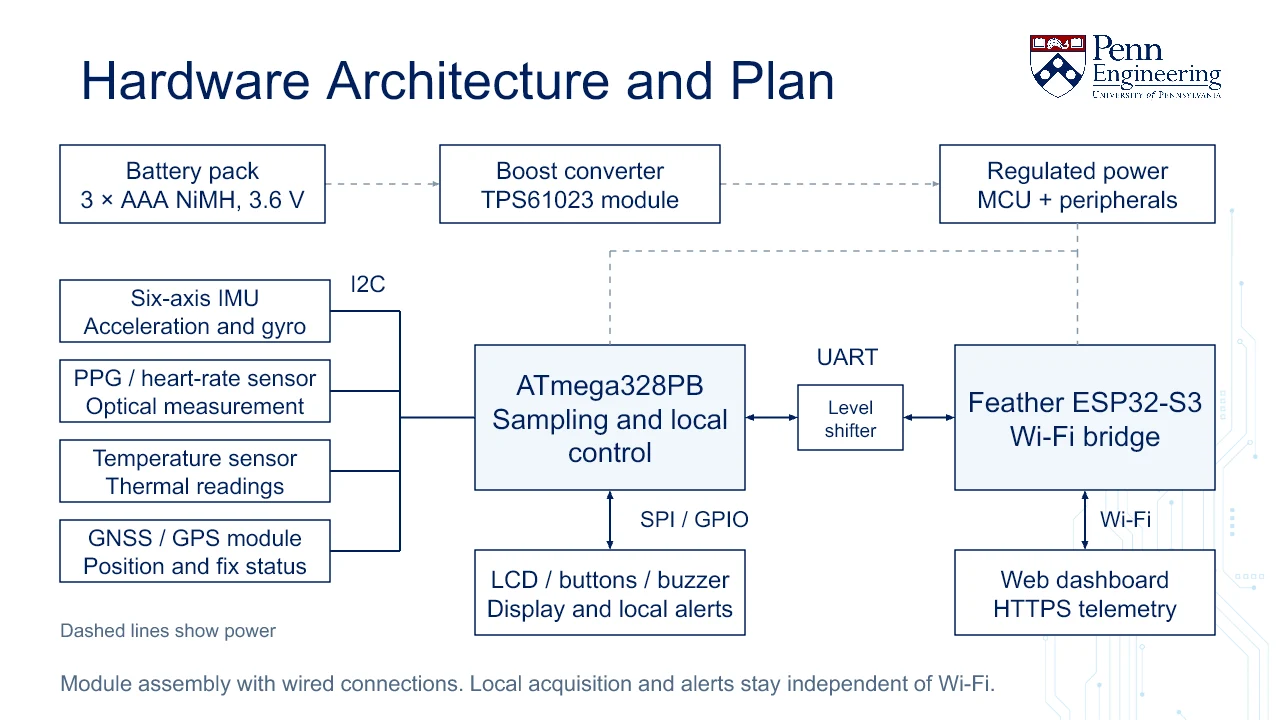
Hardware architecture
The ATmega328PB owns sensor sampling and local interaction. A Feather ESP32-S3 handles Wi-Fi transport through a logic-level interface. The module-based hardware configuration includes six-axis motion sensing, heart-rate/PPG sensing, temperature sensing and the purchased GPS module, with an LCD, buttons and a buzzer for local interaction.
Power planning uses a three-AAA NiMH battery pack, a TPS61023 boost module and regulated supplies appropriate to the boards and peripherals. Local acquisition and alert logic remain independent of cloud connectivity. The assembly uses wired modules and a prototyping arrangement.
Acquisition and transport
Timer-driven firmware acquires six-axis IMU data on a 50 Hz schedule. An interrupt-drained UART queue transmits without blocking acquisition. CRC checks, boot identifiers and sample sequences support continuity checks and expose corrupted or missing data.
The ESP32 batches readings and sends authenticated HTTPS requests. Buffering keeps wireless delays out of the sampling loop. The cloud contract checks request identity and sample offsets so retries and gaps do not silently become extra motion observations.
Streaming step estimation
The step counter estimates gravity direction, projects acceleration onto it and filters the dynamic component. Adaptive amplitude thresholds, excursion shape, gait timing and autocorrelation identify rhythmic motion. Large impacts or rapid rotation can reject a candidate interval.
Eight rhythmic candidates confirm a walking bout. Filter state and counts carry across contiguous uploads, while a sampling gap starts a new session. This is a DSP path built around the raw IMU signal, separate from the behavior classifier.
Software tests cover continuity, batching, retries and synthetic motion cases. Reference-validated step accuracy remains a separate measurement.
Behavior model and dashboard
I integrated a pretrained 17-class CNN–LSTM into a dependency-free JavaScript runtime. The model takes a one-second, 100 Hz six-axis window and dog-profile metadata. Comparing the export with an independent NumPy implementation on three synthetic windows gave a maximum probability difference of 2.44 × 10⁻⁷.
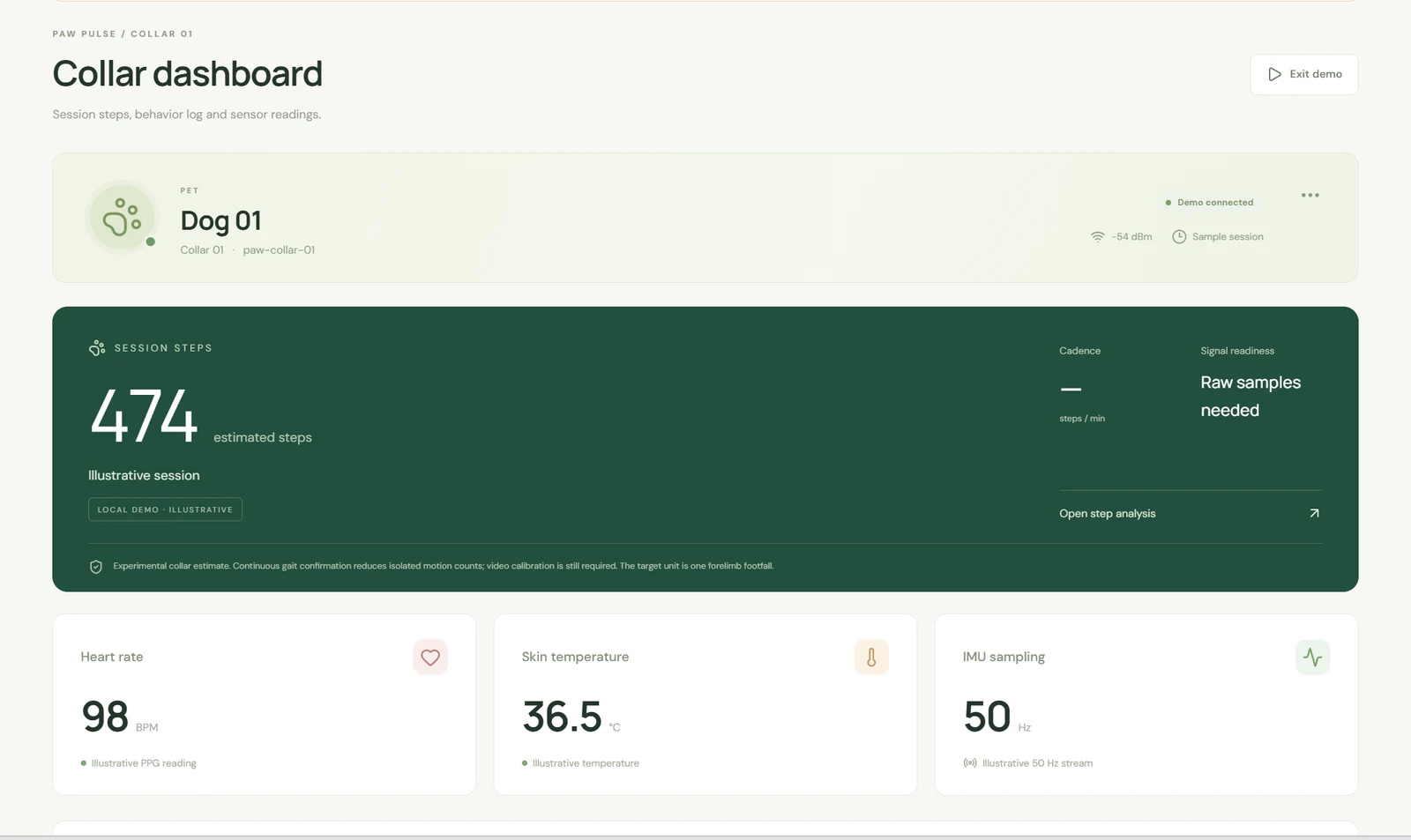
The dashboard stores telemetry and timed behavior windows in Cloudflare D1. It preserves data-source labels, distinguishes acquisition time from receipt time, merges adjacent observed windows and keeps gaps explicit. Authenticated APIs support device uploads, with CSV export for later inspection.
Numerical agreement verifies the model export, not behavior accuracy. The behavior model is adapted from the Dog Movement Recognition project.